DHI hair transplantation: what the term actually means
An implanter pen describes how grafts may be placed. It does not create a separate supply of donor hair.

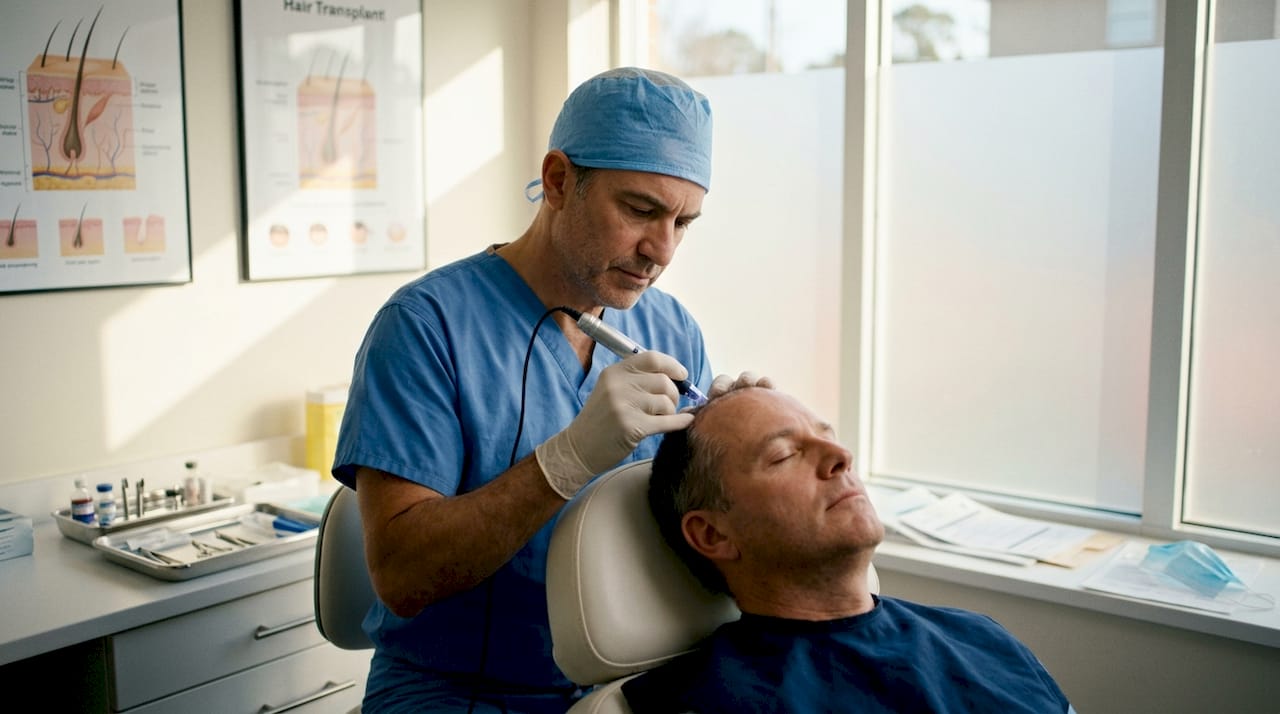
DHI usually means direct hair implantation using a pen-like instrument to place grafts. Many procedures marketed as DHI first use FUE to remove those grafts. FUE and DHI can therefore describe different stages of the same operation, rather than competing alternatives.
From donor area to recipient area
Hair transplantation involves obtaining suitable follicles, preparing the grafts and placing them into a planned pattern. FUE obtains grafts individually with a small punch. FUT obtains them from a strip of hair-bearing scalp. An implanter is a tool used at the placement stage.
Implanter techniques vary. With some instruments, a sharp tip creates the opening as the graft is placed; other approaches use sites made beforehand. Ask the clinic to describe its actual method rather than assume that every “DHI” package is identical.
The ISHRS guide to FUE explains the extraction method. Our guide to current technique names helps separate extraction, implantation and equipment claims.
What an implanter can and cannot decide
A trained team can use an implanter to position grafts, but the angle, direction and distribution must still be planned. The front of a hairline needs a different arrangement from the crown. The choice of pen does not make those decisions.
Grafts still need careful handling and appropriate storage during the operation. Loading a pen is a practical task requiring training. A claim that a tool automatically gives better survival, greater density or faster recovery needs supporting evidence, not just a product name.
DHI does not make donor hair unlimited. It does not prevent native hair from thinning in the future, and it does not remove the scars caused by extraction. The surgeon should explain both the expected benefit and the limits of the whole procedure.
Is DHI suitable for a small hairline correction?
It may be one placement option, but suitability starts with the cause and stability of the hair loss. A small area on a photograph can still need careful assessment, particularly if the surrounding hair is thinning or the donor region has already been used.
Discuss whether a lower hairline will suit your longer-term plan. Grafts used at the front leave fewer available for other areas later. Changing the instrument used to place them does not change that limit.
Shaving, discomfort and recovery
The amount of shaving depends on the planned operation and how the team needs to access the hair. “DHI” should not automatically be read as “unshaven”. Ask which areas would be trimmed, what would remain visible and whether that changes the cost or treatment plan.
Local anaesthesia is commonly used, but no technique can promise a completely pain-free experience. There may be redness, crusting, swelling or discomfort afterwards. Follow the treating clinic's individual aftercare advice , including when to wash, exercise and return to your usual activities.
What should be in a written quote?
Ask the clinic to put the proposed graft range, treatment areas, surgeon’s name, staff roles and follow-up arrangements in writing. Check whether medicines, reviews and help with complications are included. Paying more for a branded method does not prove it will give a better result.
Questions and answers
Can a procedure use both FUE and DHI?
Yes. FUE can be used to obtain the grafts, which are then placed with an implanter pen.
Does the pen extract and implant the same follicle in one movement?
No. Donor extraction and recipient implantation are separate stages. Prepared grafts must be transferred between them.
Does DHI leave no scars?
No. Donor extraction still creates wounds that heal with scars. The recipient area also undergoes a surgical procedure.
Is DHI better than every other placement method?
There is no basis for promising that to every patient. Ask why the proposed approach fits your scalp, grafts and treatment goals, and what evidence supports the claims made.