DHI stands for Direct Hair Implantation. Grafts are removed individually from the donor area and placed into thinning areas with an implanter pen. At our London clinic, we assess your hair loss and donor supply before choosing a placement method.
The pen controls the depth, angle and direction of each graft. The design of your hairline and the coverage possible still depend on the treatment plan and available donor hair.
You can arrange a consultation in London. Dr Harpreet Kalra
assesses suitability and graft requirements, and explains recovery before treatment is agreed.
Sometimes the recipient area can be treated without a full shave. Whether this suits your case depends on your existing hair and the size of the procedure. You will discuss it at your assessment.
If you are also considering a scalp FUE hair transplant, the choice depends on the treatment area, graft requirement and how important it is for you to keep your existing hair during recovery.
DHI starts from £3,499. Visit our treatment cost guide
for starting prices and quotation information, or read our FUE and DHI comparison
for the published graft-count examples. Your individual treatment price is confirmed after assessment.
Hair grows in small groups called follicular units. Each can contain one hair or several hairs together. For DHI, these units are normally removed individually from the back and sides of your scalp.
The grafts are checked, sorted and loaded into a Choi Implanter Pen. The surgeon uses the pen to make an opening and place the graft in a single movement.
The surgeon plans the hairline position and graft arrangement before using the pen. The implanter is the tool used to put that plan into practice.
How DHI relates to FUE
DHI usually starts with the same individual extraction used in an FUE hair transplant. FUE describes how grafts are removed; DHI describes inserting them with an implanter.
DHI does not provide extra donor hair. The number of available grafts still depends on the density and condition of the permanent donor area.
How a DHI hair transplant is performed
Consultation and design
At the consultation, the doctor examines your hair loss, scalp and donor area, then discusses the shape and coverage you want. Your medical history, medication and previous treatment are reviewed at the same appointment.
We draw the hairline while you are sitting upright. For crown work, the design follows your existing whorl rather than a fixed pattern.
Donor preparation
The donor area is trimmed where required and numbed with local
anaesthetic. Follicular units are then removed individually with
a small punch.
Extractions are spread across the usable donor area
to avoid taking too much hair from one section.
Preparing the grafts
The technician team checks, counts and sorts the grafts. Fine single-hair units can form the visible edge of the hairline, with grafts containing more hairs placed behind for coverage.
The prepared grafts are loaded carefully into the Choi pens before
being passed back to the surgeon.
Implantation and aftercare
The surgeon places each graft at its planned depth, angle and direction. These change to follow the surrounding hair across the treatment area.
You normally go home on the day of treatment with written instructions for washing, sleeping, exercise and protecting the grafts.
Who is suitable for DHI?
The DHI plan needs to fit your donor supply. The doctor assesses how much hair can safely be removed and the size of the recipient area, then considers whether those grafts can provide the density you want.
have a clear and established pattern of hair loss;
have enough stable donor hair for the proposed work;
want precise placement around an existing hairline;
want to retain more existing hair in the recipient area;
understand the recovery and growth timeline.
When a different plan may be better
Extensive, advanced hair loss may need a different graft plan or several procedures. DHI cannot make up for weak donor hair or provide grafts that are not there.
Active scalp disease, rapidly changing hair loss or medical factors
affecting healing also need to be assessed before surgery. In those
cases, treatment may be delayed or a different approach recommended.
How DHI compares with FUE and FUT
DHI
DHI grafts are normally removed one at a time, just as they are
with FUE.
After preparation, each graft is loaded into a Choi Implanter Pen.
The pen makes the opening and places the graft in the same movement,
so the recipient incisions are not created in advance.
FUE
During an
FUE hair transplant
,
follicular units are removed individually from the donor area.
The recipient sites are made separately before the grafts are
placed. FUE does not leave one continuous donor scar, although
every extraction leaves a small round mark.
FUT
With an FUT hair transplant,
a narrow strip of hair-bearing scalp is removed from the donor area.
The strip is separated into individual grafts under magnification.
Closing the donor wound leaves a permanent linear scar.
How much does a DHI hair transplant cost?
DHI cost depends on the graft number, treatment area and complexity of placement. Similar graft counts can still take different amounts of surgical time when treating a hairline, restoring a crown or working between existing hairs.
DHI price range£3,499–£7,000+
1,500 grafts (guide price)Around £5,000
At your consultation, we estimate the graft requirement and decide whether one procedure or staged treatment is appropriate. Before you book, the clinic should confirm the full price and what is included.
The FUE and DHI comparison linked above gives illustrative graft-count prices. If you want to spread the cost, read about our finance options
and ask for the eligibility requirements and full repayment terms before deciding.
DHI recovery and hair growth
Your donor and recipient areas need time to settle. You will receive individual instructions; the stages below give a general outline of recovery.
First 48 hours
The grafts are newly placed and must not be rubbed or disturbed.
Mild swelling, tenderness and redness can occur.
Days 3–10
Small scabs form around the grafts and gradually loosen during the
washing routine explained by the clinic.
First few weeks
The transplanted hairs can shed while the follicles remain beneath
the skin. This is a normal part of the growth cycle.
Months 3–4
Early new growth usually begins. The first hairs can look fine and
uneven before they mature.
Months 6–9
Coverage becomes clearer as more hairs grow and the earlier growth
begins to thicken.
Around 12 months
Most patients can assess the established result, although some
areas may continue to mature beyond this point.
View our patient results gallery
for the graft counts and recovery times recorded with each case. Your consultation will assess what is realistic for your donor hair and treatment area.
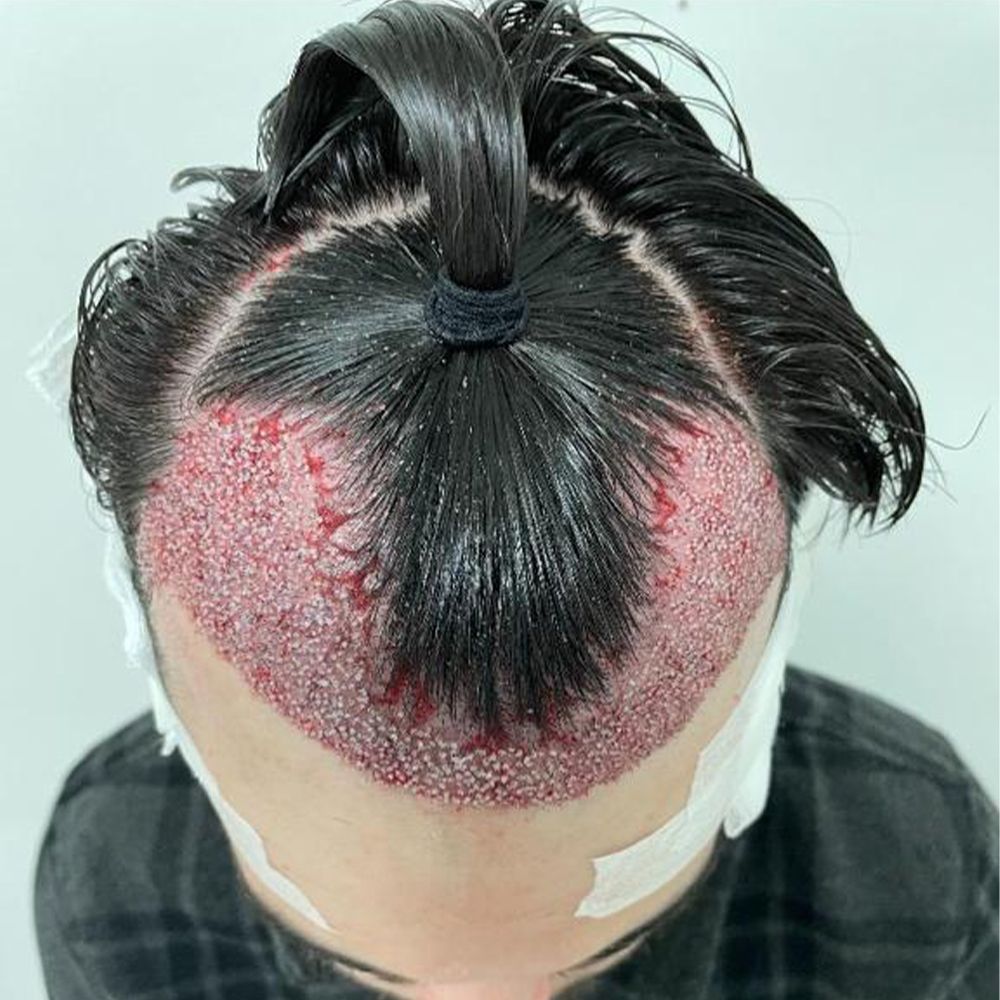
The recipient area immediately after DHI graft placement. The full patient gallery shows examples after healing and regrowth.
Dr Harpreet Kalra
Dr Harpreet Kalra
is registered with the General
Medical Council under reference 7126076. At London Hair Transplant Clinics, he performs DHI procedures with the support of a
trained technician team.
He examines your hair-loss pattern, scalp condition and permanent donor hair. This helps establish how many grafts can be taken without leaving the back and sides visibly thin.
Dr Kalra plans the hairline position, treatment area and graft distribution. He controls the angle, depth and direction of placement with the Choi pen during implantation.
Before you book, you receive a graft estimate and expected cost, with an explanation of recovery and likely growth.
DHI hair transplant FAQs
How much does DHI cost at your London clinic?
DHI prices start from £3,499. The published guide for 1,500 grafts is around £5,000. These are guide prices; your graft requirement, treatment area and complexity determine the written quotation.
Is DHI different from FUE?
DHI normally uses the same individual graft-extraction method as
FUE. The difference is the placement stage, where the prepared
grafts are inserted with a Choi Implanter Pen.
Does DHI require the whole head to be shaved?
Not always. The donor area usually needs trimming so the follicles
can be identified and removed safely. The recipient area can
sometimes be treated without being fully shaved.
Does DHI leave scars?
DHI is not scar-free. Individual donor extraction leaves small round
marks rather than the single linear scar associated with FUT.
Is a DHI hair transplant painful?
The donor and recipient areas are numbed with local anaesthetic.
Patients can feel the anaesthetic injections and some pressure or
tenderness, but the scalp is numbed during the main procedure.
When does transplanted hair begin to grow?
Early growth commonly begins around the third or fourth month.
Coverage becomes clearer between six and nine months, with the
result continuing to mature around the twelve-month point.
Can DHI be used for crown restoration?
Yes, provided the donor supply and graft plan are suitable. Crown
placement must follow the existing whorl and often requires careful
planning because the area can need a substantial number of grafts.
How long should I take off work?
Time off work depends on the extent of treatment, healing and the demands of your job. Redness and scabbing may remain visible even when you feel well enough to work. Discuss your work, travel and exercise plans with the clinical team before choosing a treatment date.